

As technology continues to evolve, many businesses are exploring innovative ways to improve production, prototyping, and product development. One question that continues to grow in popularity is what is a 3D printer and how does it work? A 3D printer is a machine that creates physical objects layer by layer using digital designs, making it one of the most exciting advancements in modern manufacturing.
At Cal-Imaging Specialists in Calgary, we believe understanding emerging printing technologies helps businesses make smarter decisions about future workflows and production solutions. In this guide, we’ll explain what a 3D printer is, how it works, the materials it uses, and why it’s transforming industries worldwide.
What Is a 3D Printer?
A 3D printer is a machine that creates three-dimensional objects from a digital file. Unlike traditional manufacturing methods that cut or shape material away, 3D printing builds objects layer by layer. This process is known as additive manufacturing.
Instead of removing material, additive manufacturing adds material only where needed, reducing waste and allowing for highly detailed designs.
Understanding what is a 3D printer helps businesses see how this technology can support:
- Rapid prototyping
- Product development
- Custom manufacturing
- Small-batch production
How Does a 3D Printer Work?
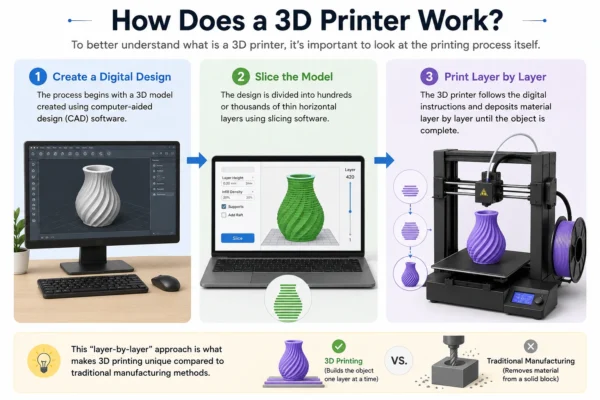
To better understand what is a 3D printer, it’s important to look at the printing process itself.
Step 1: Create a Digital Design
The process begins with a 3D model created using computer-aided design (CAD) software.
Step 2: Slice the Model
The design is divided into hundreds or thousands of thin horizontal layers using slicing software.
Step 3: Print Layer by Layer
The 3D printer follows the digital instructions and deposits material layer by layer until the object is complete.
This “layer-by-layer” approach is what makes 3D printing unique compared to traditional manufacturing methods.
What Materials Do 3D Printers Use?
One of the reasons 3D printing is so versatile is the wide range of materials available.
1. Plastic Filaments
The most common material for 3D printing is plastic, especially:
- PLA (Polylactic Acid)
- ABS (Acrylonitrile Butadiene Styrene)
These materials are commonly used for prototypes, models, and consumer products.
2. Resin
Resin printers use liquid resin hardened by UV light. Resin printing produces:
- Highly detailed objects
- Smooth finishes
- Precise designs
This is popular for jewelry, dental models, and detailed prototypes.
3. Metal
Industrial 3D printers can print using metals such as:
- Stainless steel
- Titanium
- Aluminum
Metal 3D printing is used in aerospace, automotive, and medical industries.
Types of 3D Printers
There are several different types of 3D printers, each suited for different applications.
FDM Printers (Fused Deposition Modeling)
- Most common and affordable
- Use plastic filament
- Ideal for general prototyping
SLA Printers (Stereolithography)
- Use liquid resin
- Produce highly detailed prints
- Popular for design and medical applications
SLS Printers (Selective Laser Sintering)
- Use powdered materials
- Suitable for industrial applications
- Strong and durable output
Benefits of 3D Printing
Businesses are increasingly interested in 3D printing because of its many advantages.
Faster Prototyping
Companies can quickly create prototypes without expensive tooling.
Reduced Waste
Additive manufacturing uses only the material needed for the object.
Customization
3D printing allows for highly customized products and parts.
Cost Savings for Small Production Runs
For low-volume manufacturing, 3D printing can reduce production costs.
Industries Using 3D Printers
Understanding what is a 3D printer also means recognizing its impact across industries.
Common Industries Using 3D Printing:
- Healthcare
- Automotive
- Aerospace
- Architecture
- Education
- Manufacturing
From medical implants to product prototypes, 3D printing continues to expand into new applications.
Limitations of 3D Printing
While 3D printing is powerful, it does have limitations.
Businesses should consider:
- Slower production for large quantities
- Material costs
- Learning curve for design software
- Limited size depending on printer capacity
For mass production, traditional manufacturing methods may still be more practical.
The Future of 3D Printing
3D printing technology continues to evolve rapidly. Businesses are now exploring:
- Faster industrial-grade printers
- Multi-material printing
- Sustainable printing materials
- AI-assisted design and automation
As technology improves, 3D printing is expected to play an even larger role in manufacturing and product development.
Printing Technology Solutions in Calgary
At Cal-Imaging Specialists, we stay informed about evolving printing technologies to help businesses make smarter decisions about office and production equipment.
We provide:
- Office printer sales, leasing, and rentals
- Managed Print Services
- IT and printer support
- Expert consultation on modern printing technologies
- Support for trusted brands like HP, Canon, Brother, Lexmark, and Ricoh
Our goal is to help Calgary businesses stay productive and future-ready.
So, what is a 3D printer? It’s an advanced machine that creates physical objects layer by layer using digital designs and additive manufacturing technology. From plastic prototypes to metal industrial parts, 3D printing is changing how businesses design, test, and manufacture products.
As more industries adopt this technology, understanding what is a 3D printer helps businesses prepare for the future of manufacturing and innovation.